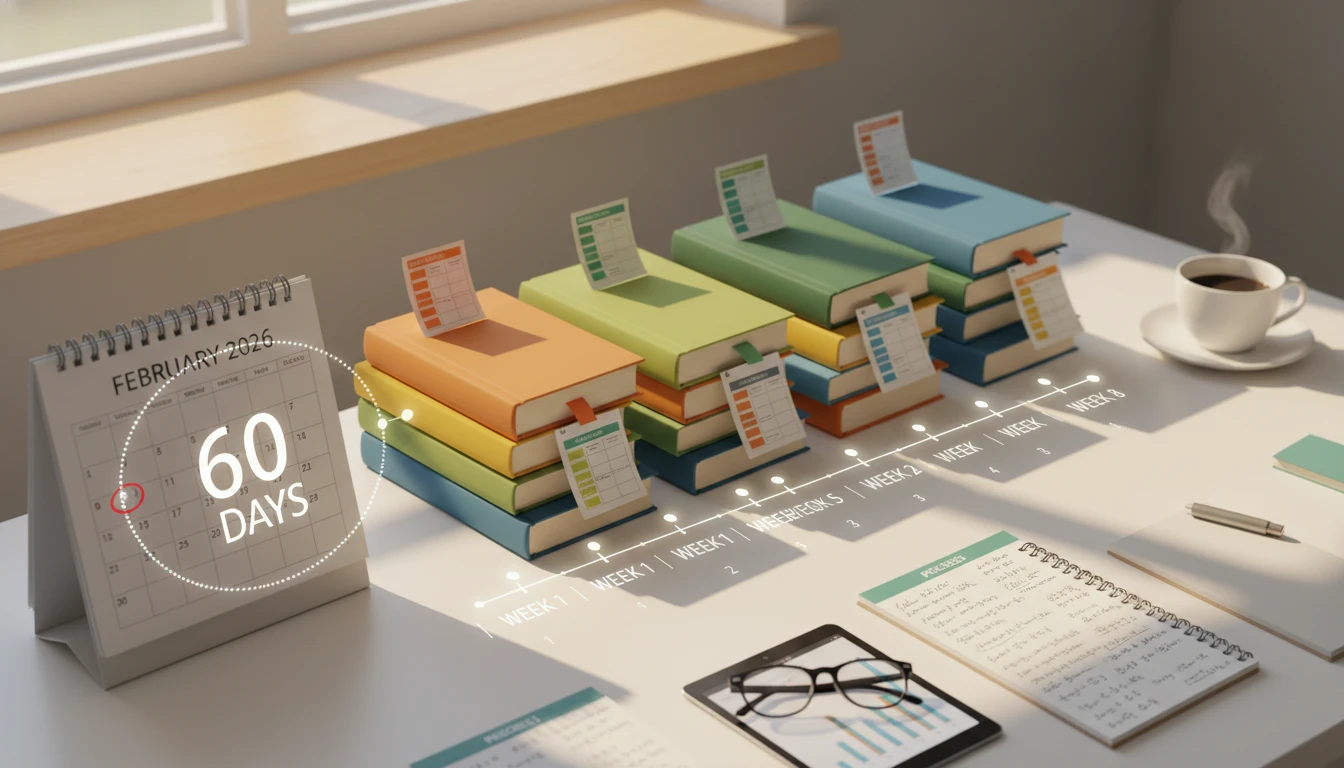
I still remember the distinct smell of eraser dust and anxiety that filled my room exactly two months before my own board exams. I looked at the calendar, and the dates seemed to be glaring back at me. Sixty days. Is that a lot? Is it nothing? It felt like I was standing at the base of a mountain with a spoon instead of a climbing pick.
Here’s the truth: 60 days is the “Goldilocks zone” of study timelines. It’s not so long that you’ll burn out before the finish line, but it’s not so short that you have to rely on caffeine-fueled all-nighters. If you’re staring down the barrel of February 2026, take a deep breath. We aren’t going to panic; we’re going to strategize.
Effective CBSE preparation isn’t about how many hours you sit at your desk; it’s about what you do with those hours. Let’s break this down into a manageable, week-by-week roadmap that turns that mountain into a series of walkable hills.
Phase 1: The Audit & The Foundation (Days 1–14)
Week 1: The Brutal Honest Audit
Imagine trying to build a house without checking if the ground is solid. That’s what studying is like without an audit. Spend your first three days doing nothing but reviewing your syllabus and previous tests.
- Categorize: Mark every chapter as Green (Confident), Yellow (Needs review), or Red (No clue/Terrified).
- Resource Gathering: Ensure you have the latest NCERTs and sample papers. Do not hoard books. One primary text and one reference per subject is plenty. Analysis paralysis is real.
Week 2: Eating the Frog
Mark Twain once said that if you have to eat a live frog, do it first thing in the morning. Your “frogs” are those Red-category chapters. In Week 2, tackle the hardest, most conceptually difficult topics while your brain is fresh and panic hasn’t set in yet. Don’t worry about speed; worry about understanding. If you master Calculus or Organic Chemistry now, the rest is downhill.
Phase 2: The Deep Dive & Consolidation (Days 15–35)
Weeks 3–4: The 80/20 Rule
Now we shift gears. Apply the Pareto Principle: 80% of your results come from 20% of your efforts. In the context of CBSE exam preparation, this means focusing on high-weightage chapters.
- The Schedule: Break your day into three 2-hour blocks rather than one 6-hour marathon.
- Block 1: Heavy conceptual learning (Sciences/Math).
- Block 2: Application and solving (Numerical problems/Grammar).
- Block 3: Light reading or revision (English/Social Science).
Week 5: The Mid-Point Review
By now, you might feel a slump. This is normal. Take a full day off—yes, really. Go for a walk, watch a movie, reset your cortisol levels. When you return, take a mock test for two subjects. You aren’t doing this for marks; you’re doing it to see if your “Red” topics have turned “Yellow” or “Green.”
Phase 3: The Simulation (Days 36–50)
Weeks 6–7: Examination Condition Training
This is where most students falter. They know the material but haven’t trained for the event. Knowing how to box is different from lasting 12 rounds in the ring.
During these two weeks, your biological clock needs to align with the CBSE schedule. If your exam is from 10:30 AM to 1:30 PM, that is exactly when you should be solving sample papers. No music, no snacks, no phone breaks.
- The Feedback Loop: Spending three hours writing a paper is useless if you don’t spend three hours analyzing it. Where did you lose marks? Was it a silly calculation error (focus issue) or a conceptual gap (knowledge issue)? Fix the gap immediately.
Phase 4: The Taper (Days 51–60)
Week 8: The Final Polish
Athletes taper their training right before a marathon to let their muscles recover. You need to do the same for your brain. Stop learning new things. If you don’t know it by Day 55, trying to cram it in now will only push out information you actually know.
- Focus: Review your own short notes, formula sheets, and the mistakes you made in Phase 3.
- Sleep: Prioritize sleep over revision. A tired brain makes 30% more errors than a rested one.
Final Thoughts
The difference between a stressful February and a successful one usually boils down to the plan you stick to. Remember, this roadmap isn’t written in stone—it’s written in pencil. Adapt it if you get sick or if a topic takes longer than expected.
You’ve got 60 days. That’s 1,440 hours. You have more than enough time to turn things around, provided you start today. So, which chapter are you tackling first?
Like this:
Like Loading...


 Skoodle Jumbo Dust-less Color Eraser (Pack of 20)
 Skoodle Triangular Mini Color Pencils 10 shades
₹15.00
Skoodle Triangular Mini Color Pencils 10 shades
₹15.00
 Skoodle Triangular Neon Pencil (Pack of 100)
 Skoodle Triangular Neon Eraser (Pack of 100)